

What if your next trip was able to provide you with a bank of pleasant personal memories and still leave a positive legacy for the communities and the people you meet? That’s the quest of sustainable travel, which sets out a vision for exploring the planet today without limiting the potential for future generations to do the same. Beginners are most certainly welcome, so if you’ve already mastered our sustainability tips for the home, here’s how to take those skills on tour!

What is sustainable travel?
Tourism might be a vital economic driver worldwide, employing one in 10 people on earth, but like a bad airline, it frequently comes with the wrong type of baggage.
The downside of travel
- Produces 3 percent of global greenhouse gas emissions, with just 20 countries responsible for 75 percent of those.
- Inflates local rental markets, to the point where platforms like Airbnb are now banned or severely restricted in New York, Barcelona, Berlin, Paris, and other popular hot spots.
- Generates 8 million tonnes of solid waste a year, including a mountain of single-use plastics. If you’ve seen the pictures of Everest Base Camp, you’ll understand the damage.
- Strains local infrastructure, overloading fragile transport, water and energy systems that aren’t designed for such volume.
- Overwhelms local culture and heritage. For example, Venice has more tourists than locals, while hiking and skiing hotspot Andorra averages 33 tourists for every resident.
Sustainable travel takes a different route, focusing on low climate impact, a “leave only footprints” ethos in terms of local communities, and the goal of delivering a positive benefit to the places we visit.
Without a shift towards sustainable travel, the list of famous and historic sites that are now entirely off-limits or severely restricted to visitors will grow beyond these notable destinations:
Places that are now closed or restricted to tourists
- Maya Bay, Thailand, aka ‘The Beach’
- Stonehenge in England
- Chichen Itza in Mexico
- Uluru in Australia
- Machu Picchu in Peru
- Angkor Wat in Cambodia
- Cinque Terre in Italy
- The Acropolis in Greece.
How to travel sustainably
Beginners don’t have to accumulate air miles to earn their sustainability wings. You can incorporate a sustainable approach into your very first trip.
Adopt the mindset
“Travel is wonderful, important, and a privilege,” says Justin Francis, co-founder of Responsible Travel, the world’s first responsible tourism company, “but it’s unsustainable like this.” He advocates applying the same mentality to vacations that we have applied to food and clothing. That means thinking long-term, choosing with intent, and using our spending power for a more positive purpose.
Limit and offset your carbon footprint
First you’ll need to calculate the carbon footprint of your planned trip, perhaps eliminating those flights or resorts that go off the scale. You can then purchase carbon offsets that are invested in projects that reduce or remove emissions, to reduce the overall impact of your journey. For those trips where flights are unavoidable, you can pick your airline by applying lower emissions filters to sort results by emissions instead of price.
Certain decisions require no calculations.
- Travel by train instead of plane, especially for short-haul journeys. Trains typically produce 90 percent fewer greenhouse gas emissions.
- Choose a bike instead of a car. It’s also a great way to explore new cities, and e-bikes have eliminated many of the physical and accessibility barriers.
- Lean towards short-distance trips instead of long-haul travel. Let’s be honest, most of us haven’t even explored our own country fully.
If you must fly
According to Francis, the idea that we can simply offset our way out of a crisis is a myth. “Aviation emissions are instant and can linger for hundreds of years: planting a sapling is no remedy.”
His advice? “Fly less. Stay longer instead and make your trip count.”
Stay sustainably
Staying in a luxury hotel or resort is certainly an indulgent treat, but many of us feel guilty about the cost of our comfort in terms of air conditioning, laundry, and even the discarded soaps and toiletries we leave behind.
Many large hotels, especially in developing countries, devour power and water from already stressed infrastructures. That means local communities are deprived of essential resources without experiencing any economic benefits other than low-paid service work.
Untaxed revenue diverted overseas, away from the local market, is one of the unsightly faces of modern tourism. According to Kaitlyn Brajcich of Sustainable Travel International, “Most of a traveler’s spending never reaches the destination.” Whether it’s cruise ship tours or all-inclusive beach resorts, there’s no trickle-down dividend. In the Caribbean, for example, “as much as 80% of tourism spending leaves the local economy,” says Brajcich.
The solution? Choose locally owned or managed hotels, guesthouses or eco-lodges. If you must book at a larger resort, venture beyond the fence to explore local eateries, markets and activities. Look also for less energy-intensive options, such as hotels that have invested in solar power, low-flow water fixtures and recycling and the elimination of single-use plastics. Just as you look for green certifications on your domestic purchases, look for LEED or Green Key certifications on your travels.
Staying sustainably can mean staying longer in one place, too. As Francis says, “Wherever you travel, slow down and think local.” Local guides provide fresh, rich insights, so instead of rushing through a destination to accomplish a bucket list of selfies, get to know a place that’s charmed you. Take a cooking class, visit a local artisan to learn local crafts, and take public transport to get an idea of daily life.
Travel light and eat local
Limit any negative impact of your brief passage through a destination by reducing the amount of resources you introduce, or require, while you’re there. Single-use plastics are an obvious culprit, whether it’s food packaging or water bottles. Even cosmetics can have a negative environmental impact.
If you can travel with the essentials and buy what you need when you arrive you’ll be supporting local businesses and adapting better to local conditions.
Choose greener destinations
As a beginner, you’re entitled to enjoy the same iconic destinations as experienced travellers, but be honest about what’s driving your choices, and pragmatic about the alternatives.
In many cases, there’s often a ‘hidden gem’ in a country that’s typically famous for an iconic landmark. Do your research and prepare to stray from the beaten path.
Instead of lining up from dawn to get your shot of the Taj Mahal, for example, there are plenty of equally impressive mosques and monuments across India that you can tour in peace.
That’s the spirit of adventure that Francis encourages. “We’re steered by algorithms into already crowded spaces,” he says. “These places we visit are often historical, fragile and sacred sites.”
He urges travellers to avoid Instagram as inspiration for a trip and even to put away your camera once you’re there. “Not every moment has to be filmed. Social media can be great, but it shouldn’t control how, where and why we travel,” he warns.
Support tours that build communities
Should you travel independently or sign up for a tour that takes care of the logistics?
“There isn’t anything inherently wrong with organized tours,” says Brajcich, but “try to choose operators that intentionally build sustainability into their trips.” That way the local community benefits, whether they’re guides, suppliers or transport.
How should you choose a sustainable tour when the country you’re visiting might be thousands of miles away and speak a different language?
- Start by calculating the Ripple Score of your trip (or similar) to see how much value stays in the destination. You’ll be surprised at how many high-profile excursions, often when booked before departure, are run by operators not registered in the country.
- Try to choose lower-impact tours with a more immersive theme. Walking, cycling or kayaking, for example, instead of hopping on and off a vehicle according to a tight schedule.
- Where available, pick ecotourism experiences that reinvest in local communities, such as protecting forests in Cambodia that are home to endangered elephants and gibbons, providing efficient and safer cookstoves to communities in India, or supporting beach cleanup efforts in Mexico. It can be significantly more rewarding than passively snapping at sights from a tour bus.
Your sustainable travel packing list
If you want to travel light and stay sustainable, find a pocket in your backpack for these tried and tested essentials.
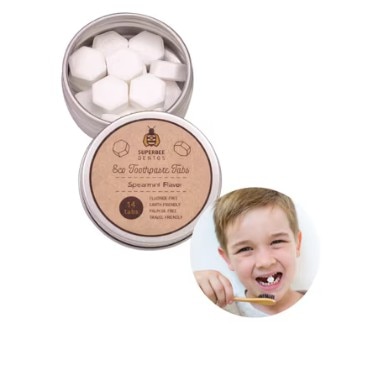
Superbee Eco Toothpaste Tabs Travel Pack
![Superbee Eco Toothpaste Tabs Travel Pack -- 14 Tablets]() The Humble Co Bamboo Toothbrush Travel Kit
The Humble Co Bamboo Toothbrush Travel Kit

Fomin’ Travel Soap Sheets Tin – Tea Tree Oil

New Wave Enviro Alkaline Refillable Water Bottle With Replaceable Filter