
America needs blood. Unfortunately, few of the nation’s citizens are responding to the call.
Just 3% of eligible donors give blood, according to the American Red Cross. The organization notes that a lack of donations means blood supply doesn’t always meet demand.
The benefits of donating blood
Giving blood is a painless way to help your fellow citizens in need. Here are some things you should know if you are ready to donate this precious and life-saving resource.
Blood is needed every 2 seconds
Every two seconds in the U.S., someone needs a blood donation. Blood is necessary for many types of medical care, including:
- Surgeries
- Cancer treatment
- Treatment of chronic illnesses
- Care of traumatic injuries
When you donate, you can give whole blood, or components of blood such as red cells, platelets or plasma.
“What many people do not understand is that once a unit of blood has been donated, it can support multiple patients who may have received different units of blood,” says Brian Clark, a certified registered nurse anesthetist and founder and CEO of United Medical Education, which provides emergency life-saving training to both medical professionals and nonprofessionals.
There are 4 major blood types
Blood types can be divided into the following categories:
- Group A
- Group B
- Group AB
- Group O
The presence or absence of specific antigens determines your blood type. Antigens that are foreign to your body create an immune response, attacking the new blood.
For this reason, blood types must be the right match for the recipient if the transfusion is to be safe.
Hospitals most often request the O blood type. That is because this type of blood can be used in any transfusion. Unfortunately, this type of blood is often in short supply.
You must meet key criteria before donating
Not everyone is eligible to donate blood. In most states, you must be 17 years old, although other states allow those who are 16 to donate if they have parental consent, according to the American Red Cross.
Most adults must weigh at least 110 pounds before donating, the Red Cross says. There may be additional weight requirements for those who are 18 or younger.
In addition, you must be in general good health and not feeling sick. Finally, you cannot donate if you have given blood in the previous 56 days.
You should eat and drink right before you give blood
Taking the right preparatory steps can boost the odds of having a great donation experience.
“Drinking plenty of water prior to arriving at the donation center, eating something before arriving and getting plenty of rest will make the process much easier for the donor to tolerate,” Clark says.
On the day you give blood, you should drink an extra 16 ounces of water before your appointment, according to the Red Cross.
It also can be helpful to eat some iron-rich foods prior to donating, such as red meat, fish, poultry or spinach.
Some people find it helpful to have access to their favorite music so they can enjoy it while they donate.
You will be asked some basic questions before donating
Prior to giving blood, you will likely register by signing in and showing an ID. You will then be asked to read some information about giving blood.
You also will answer some basic questions either online or in an in-person interview before the donation. A general health check – something like a “mini-physical” – will be part of the process. It will include screening of your:
- Blood pressure
- Hemoglobin
- Pulse rate
“When screening begins, it may seem like a very personal thing,” Clark says, but he adds that gathering such information “is protecting both the donor and the recipient.”
The donation process is short
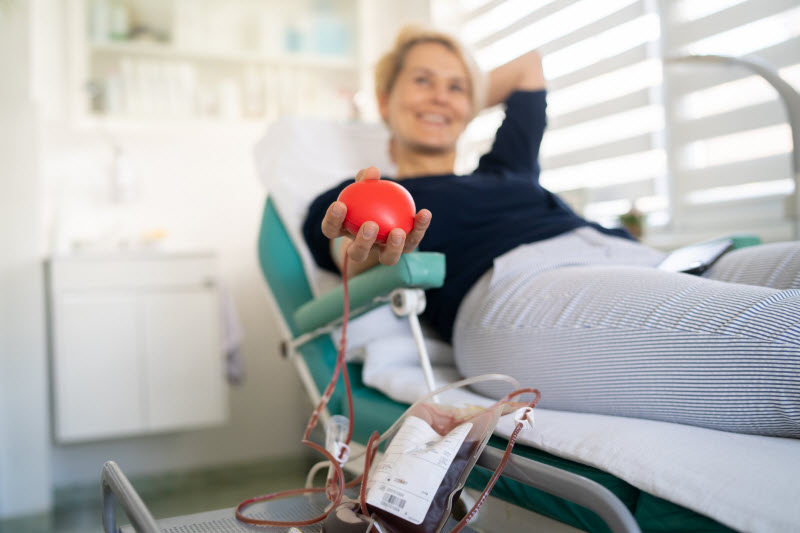
In most cases you can expect your donation to take about 10 minutes or less. You will sit comfortably with a needle in your arm as a pint of blood is drawn.
“The ‘needle’ portion of the donation is typically over quickly,” Clark says.
After testing, the facility will likely give you a drink and snack and ask you to rest for about 15 minutes.
“The post-donation observation period helps to ensure that the donor remains stable and able to safely return home,” Clark says.
At that point, you will be sent on your way to enjoy the rest of your day.
Your blood will be tested
Your blood will be tested before it is sent to a patient in need. The blood will undergo testing for Rh factor, which is a protein found on red blood cells. The presence or absence of Rh factor helps determine your blood type.
Your blood also will undergo sickle cell trait screening and testing for infectious disease. Some of the diseases the testing will screen for are:
- Hepatitis B and C
- Human immunodeficiency viruses (HIV)
- Syphilis
- Zika virus
- West Nile virus
Once your blood has been tested and assigned a blood group – O, A, B or AB – and Rh type, it will be ready for donation.
Giving blood is safe
Safety is often one of the biggest concerns of first-time donors.
“For most healthy adult donors, the risks associated with blood donation are extremely low,” Clark says.
Some people worry about contracting AIDS or another infectious disease when they give blood.
However, new, sterile needles are used for every donation, and then immediately discarded.
In addition, the mini-physical that is performed before donation helps to make sure you are in good shape and that your health will not be at risk during the donation process.
Some people worry that giving blood will put them at risk of fainting. But the Red Cross reminds you that the pint of blood you donate is a small portion of the 10 pints of blood in your body.
In fact, some components you lose during a donation are replenished within hours, while others take a few weeks.
“If a donor becomes lightheaded during or after the donation, or develops a bruise at the puncture site, it is likely going to require nothing more than hydration and rest to resolve,” Clark says.
Blood donors who donate frequently will lose some iron and should space out their donations, eat foods high in iron, and talk to their health care provider about ways to replenish the iron they lose, Clark says.
Featured Products